About Sutton
Sutton is a small hamlet of some 300 people, located in Bedfordshire near the towns of Potton, Sandy and Biggleswade. It comprises a church, school, public house, golf club and a village hall.
You can find out more about the village, including the vision for the future in the Sutton Neighbourhood Plan.

Origins

All Saints Church was built in the 12th Century and Sutton Castle soon after, cerca 1220.
In the 14th Century, John of Gaunt, son of King Edward III, resided close to where the John O'Gaunt Golf Club is now.
Sutton Packhorse Bridge
The beautiful Packhorse Bridge over Potton Brook was built in the 14th or 15th Century to support wool transportation between the towns of Bedford and Dunstable.
It provides an ideal location for the very popular Sutton duck race, usually held in early summer

Sutton's medieval kiln
Prior to the construction of a new multi-use sports pitch at Sutton Primary School in 2025, Central Beds Council decided to do a dig to look for any interesting history beneath the site. Archaeologists then found what they believed to be a 16th century kiln which would have been used to make pots for the surrounding area. They felt it might well have been in operation while Henry VIII or Elizabeth I reigned.


However, subsequent work has established that the kiln might be as old as the late 14th century which means it may have been in operation at the time of the War of the Roses. David Ingham, Albion Archaeology Project Manager: "We already knew that medieval pottery was made at Everton, but finding a large kiln producing similar pottery three miles away at Sutton suggests that this area of Central Bedfordshire played a much more significant part in the region's medieval pottery industry than we previously realised. The kiln was probably used at some point in the decades following the Black Death."
The kiln would have had a dome over the top to keep the heat in and enable mass production. At the time of the dig, archaeologists working in Sutton filled 180 large white buckets with more than 30,000 pottery fragments. No examples of complete pots were found, presumably because the only ones left there when the kiln was abandoned would have been broken or discarded pieces.

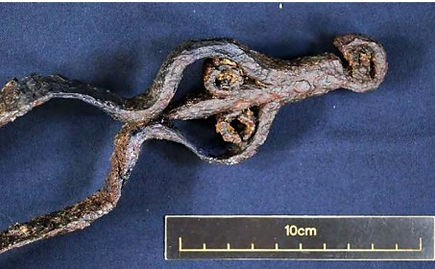
An intriguing artefact was found whose purpose remains a mystery. It looks like a set of iron tongs but its decorative fleur-de-lis makes it seem more than an industrial tool.
Also found was the skeleton of a dog!
Although the kiln has now had to be filled in to protect the remains from the elements, the archaeological findings will live on through extensive documentation, detailed research and 3D models.


A scaled model of the kiln made by Bedford Young Archaeologists Club and some of the finds will feature in a six-month exhibition at The Higgins Bedford until 4th October 2026, exploring medieval and Roman kiln sites across the county.

Sutton's history
For more information on Sutton's history, please see the following sources:
National Archive - catalogue for the sale of Sutton Park Estate in 1939